


IML Containers as a Branding Tool
Blogs > IML Containers as a Branding Tool
How Private-Label Brands Turn Packaging into Free Marketing
Written by the product and export team at Damati Innovations, a food-grade polypropylene container manufacturer producing IML and injection-moulded packaging since 2003. Reviewed for technical accuracy against current production practice across our Silvassa, Daman, and Paria manufacturing facilities. Last updated August 2026.
If you run brand or marketing decisions for a dairy, ice cream, or QSR private-label line, packaging probably shows up on your budget sheet as a cost line — something to minimize. That’s the wrong lens. The container your product ships in is the one piece of marketing that touches every single customer, every single time, with zero media spend attached. An IML container (in-mold labeling) is what makes that marketing asset actually work — durable, shelf-ready, and built to look premium long after a sticker would have peeled.
This isn’t a piece about moulding technology or production tooling — we’ve already covered that ground. This one is for the person deciding whether IML packaging is worth the line-item, and what it actually buys you over conventional labeling. Everything below reflects what we see day to day running IML production lines for export and domestic dairy, food service, and QSR clients — not just what’s written about the category elsewhere.
In-Mold Labeling vs. Sticker Labels: What Actually Changes
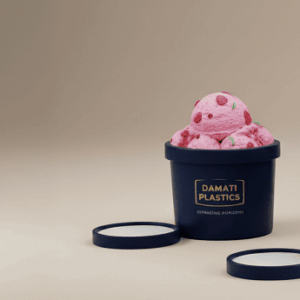
A stuck-on label is applied after the container is formed — it’s a separate step, a separate point of failure, and a separate cost that repeats on every unit. An IML plastic container fuses a pre-printed film into the container wall during moulding. The graphic isn’t sitting on top of the plastic; it becomes part of it.
That difference shows up in three places a brand manager actually cares about:
● Shelf life of the label, not just the product. Condensation, freezer burn, cold-chain handling, and repeated fridge-to-counter cycles all peel stickers. In our own returns and quality data, sticker-label complaints cluster almost entirely around cold-chain and high-humidity routes — exactly the conditions dairy and ice cream shipments run through. An IML food container keeps its graphics intact through all of it — no curling corners, no faded print, no “which SKU is this” moment at the retail cooler.
● Perceived quality. A no-label, seamless finish reads as premium even on a mid-price product. For private-label dairy and ice cream brands competing against national brands on the same shelf, that visual parity matters more than most marketing spend.
● Print fidelity at volume. IML supports full-color, edge-to-edge graphics, gradients, and fine text that sticker printing struggles to hold consistently across large production runs — useful if your brand identity leans on color-coded flavors or variants, which most IML ice cream containers do.
Why This Is a Shelf-Stand-Out Decision, Not a Packaging Decision
Walk any freezer aisle and the containers that catch the eye first are rarely the ones with the loudest color — they’re the ones where the branding looks like it was built in, not stuck on. For QSR chains packaging takeaway dairy or dessert items, and for private-label brands going up against category leaders, that seamless look is doing the job a shelf-talker or secondary display would otherwise have to do. It’s passive marketing that never turns off.
This also matters more than it used to. Buyers evaluating IML plastic container manufacturers today aren’t only comparing print quality — they’re weighing recyclability (mono-material, food-grade polypropylene builds are increasingly a retailer requirement, not a nice-to-have), how well the lid reseals after repeated use, and whether the artwork survives real distribution handling, not just a showroom sample. That’s a distinction we test for directly — export shipments to markets across the Gulf, Africa, and Southeast Asia go through longer transit and more handling cycles than domestic runs, and it shows up fast if the label-to-container bond isn’t right.
The Cost Question: Branded Packaging vs. the Marketing Value It Replaces
The honest comparison isn’t “sticker cost vs. IML cost” — it’s “IML cost vs. the marketing you’d otherwise spend to get the same shelf impact.” A generic tub with a sticker needs something else to do the differentiation work: secondary packaging, in-store POS material, repeat digital ad spend to build recognition. A well-designed IML container does a meaningful part of that job at the point of purchase, for the life of every unit you ship, with no recurring cost per impression.
Where IML costs more is tooling — the custom mould for your artwork is a one-time capital cost, not a per-unit one. That’s exactly why the next question matters so much.
Minimum Order Quantities: The Real Gatekeeper
This is usually where the conversation stalls for smaller or newer private-label brands. Custom IML plastic container runs require a dedicated mould per design, and manufacturers set MOQs to make that tooling investment worthwhile. The exact number varies by container size, cavity count, and artwork complexity — which is why we quote it against the actual SKU, not a blanket figure. Brands often start with one or two hero SKUs on custom IML (their bestseller or their most photographed product) and keep smaller-volume variants on standard stock containers until volume justifies the switch. If your production is split across dairy, ice cream, and QSR lines, consolidating artwork across a shared container shape is usually the fastest way to hit a workable MOQ sooner — it’s the single most common piece of advice we give brands at the quoting stage.
Where This Is Heading: What to Watch For
A few shifts are already showing up in how brands and manufacturers are approaching IML packaging, and they’re worth planning around now rather than reacting to later:
● Sustainability as a retailer requirement, not a brand choice. Mono-material polypropylene builds — where the label film and the container are the same recyclable resin — are moving from “nice positioning” to something buyers ask for directly, partly driven by carbon-labeling and anti-greenwashing pressure on retailers.
● Smart packaging. QR codes and NFC tags built into IML graphics are starting to appear on premium dairy and ice cream lines, turning the container into a link to recipes, loyalty programs, or traceability information — a natural extension of a surface that’s already branded.
● Accessibility-driven design. Easier-grip lids, tactile cues, and ergonomic reopen mechanisms are becoming a differentiator in categories like ice cream and deli tubs, where repeat at-home use matters.
● Faster, shorter design cycles. Digital printing improvements are shortening the time between artwork approval and production-ready film, which is starting to make smaller, more frequent design refreshes viable even within IML’s mould-based model.
For brand managers, the practical takeaway is the same across all four: the container is no longer just packaging spec — it’s a channel. Brands that treat it that way now will have an easier time adopting whichever of these becomes table stakes in their category first.
A Note on Getting This Right
None of the above is a substitute for a mould feasibility check on your specific artwork and container size — cavity count, film registration tolerances, and resin choice all affect what’s actually achievable, and a manufacturer should walk you through those trade-offs before you commit tooling budget. We’d rather tell a brand a design needs adjusting at the quoting stage than after a mould is cut.
The Bottom Line
If you’re weighing IML container packaging against conventional stickered tubs, the real question isn’t “which costs less per unit.” It’s “what is this container doing for the brand on every single shelf, in every single hand, at zero incremental marketing cost.” For private-label dairy, ice cream, and QSR brands competing against players with far bigger ad budgets, that’s not a packaging upgrade — it’s the most efficient marketing spend on the P&L.
Damati Innovations has manufactured food-grade polypropylene packaging since 2003, with facilities in Silvassa, Daman, and Paria (Gujarat) and an international office in Dubai, exporting to 20+ countries. Talk to our team about mould feasibility, MOQs, and turnaround for your product line.
